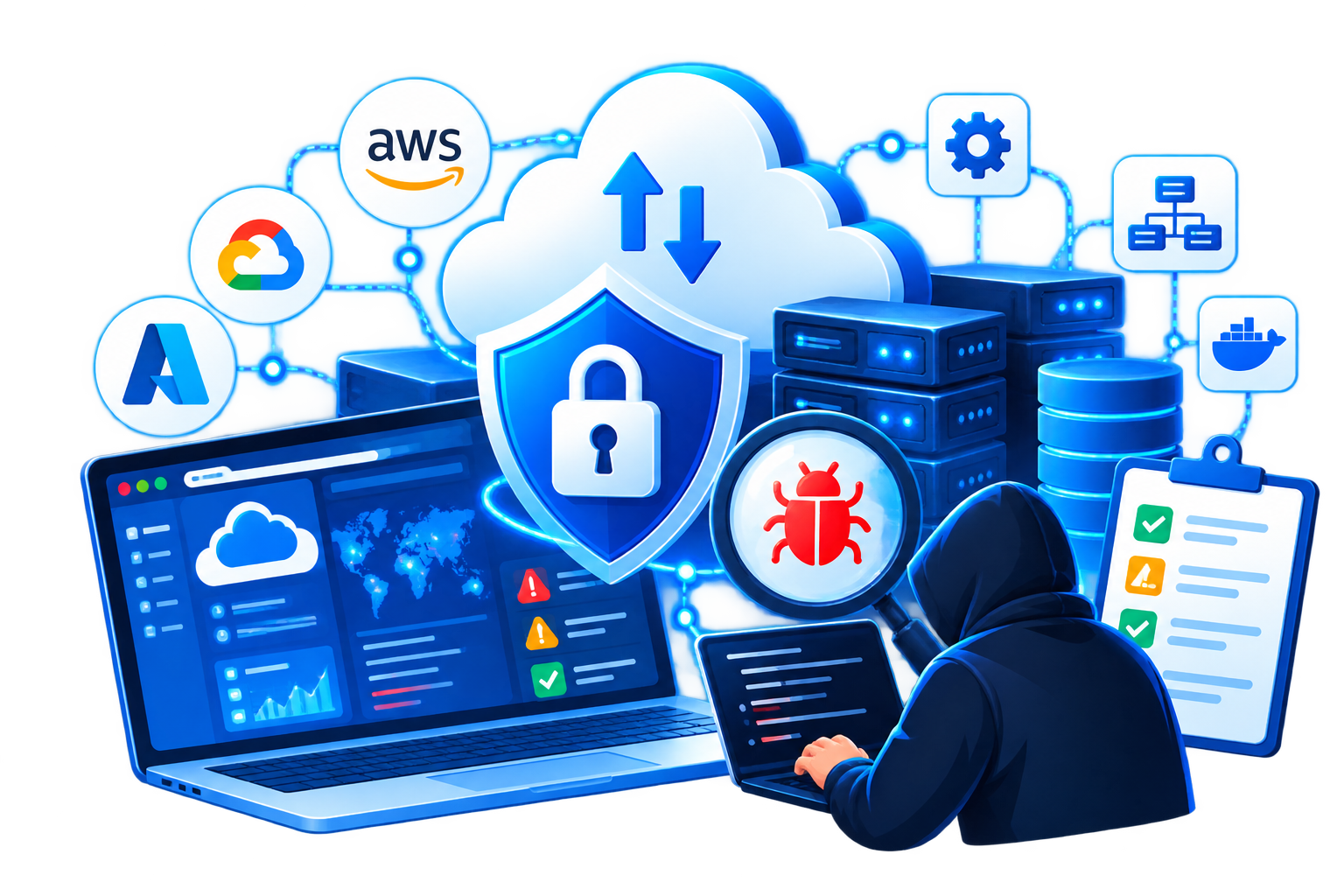
Cloud Penetration Testing

Identify cloud vulnerabilities before attackers do. PRSecurity performs comprehensive cloud penetration testing to uncover security weaknesses across your cloud infrastructure, applications, identities, storage, APIs, and configurations.

  • Identify Critical Cloud Security Vulnerabilities
  • Protect Cloud Infrastructure & Sensitive Data
  • Strengthen Cloud Environments Against Cyber Attacks

DEFINITION

What Is Cloud Penetration Testing?

Identify security weaknesses before attackers can exploit them. PRSecurity helps you discover, validate, and remediate vulnerabilities across your cloud environment.


Cloud Penetration Testing is a controlled security assessment that simulates real-world cyberattacks against cloud infrastructure and services. It evaluates cloud configurations, identity and access management, storage, networking, APIs, virtual machines, containers, applications, and security controls to identify vulnerabilities and determine how attackers could potentially gain unauthorized access.


Our testing provides actionable recommendations to reduce your cloud attack surface, strengthen security controls, and improve your overall cloud security posture.

Types of Cloud Penetration Testing

PRSecurity performs comprehensive cloud security testing to identify vulnerabilities across your cloud environment from identity and access controls to storage, networking, workloads, APIs, and cloud configurations.

01 - Cloud Infrastructure Penetration Testing

Assess cloud-hosted infrastructure, virtual machines, compute resources, network configurations, and exposed services for vulnerabilities that could provide attackers with unauthorized access.
02 - Cloud Configuration Security Testing

Identify insecure configurations across cloud resources, security groups, access policies, exposed services, logging, monitoring, and other cloud security controls.

03 - Identity & Access Management Testing

Evaluate IAM policies, roles, permissions, service accounts, privileged accounts, and authentication mechanisms to identify excessive privileges and potential privilege escalation paths.
04 - Cloud Storage Security Testing

Assess cloud storage services and repositories for publicly accessible data, weak access controls, exposed credentials, sensitive information, and insecure permissions.

05 - Cloud Network Security Testing

Test virtual networks, security groups, firewalls, routing, VPNs, gateways, and segmentation controls to identify weaknesses that could enable unauthorized access or lateral movement.

06 - Cloud API & Application Testing

Assess cloud-hosted APIs and applications for authentication weaknesses, authorization flaws, injection vulnerabilities, data exposure, insecure endpoints, and other application-level risks.

07 - Container & Kubernetes Security Testing

Assess containers, container registries, orchestration platforms, Kubernetes configurations, workloads, secrets, permissions, and exposed services for security weaknesses.

08 - Serverless Security Testing

Evaluate serverless functions, event triggers, permissions, dependencies, APIs, environment variables, and execution controls for vulnerabilities and excessive privileges.

09 - Cloud Attack Path & Privilege Escalation Testing

Identify realistic attack paths that could allow an attacker to move from an initial foothold to higher privileges or access sensitive cloud resources.

What Does Cloud Penetration Testing Cover?

Our cloud penetration testing evaluates the security of your cloud environment across infrastructure, identities, applications, workloads, and data.

Cloud Infrastructure

Virtual machines, compute instances, cloud resources, exposed services, and infrastructure configurations.

Identity & Access Management

Users, roles, policies, service accounts, privileged identities, authentication mechanisms, and access permissions.

Cloud Storage & Data

Object storage, databases, backups, file storage, sensitive information, access policies, and public exposure.

Cloud Networking

Virtual networks, subnets, security groups, firewalls, gateways, routing, VPNs, and network segmentation.

APIs & Cloud Applications

Public and private APIs, authentication mechanisms, authorization controls, application endpoints, and integrations.

Containers & Kubernetes

Container images, registries, workloads, Kubernetes permissions, exposed services, secrets, and orchestration configurations.

Serverless Workloads

Functions, triggers, permissions, environment variables, dependencies, and serverless APIs.

Logging & Security Controls

Cloud logging, monitoring, detection controls, security configurations, and visibility into suspicious activity.

Key Cloud Security Areas We Assess

We assess critical cloud security controls across identities, data, infrastructure, applications, workloads, and configurations to uncover vulnerabilities, reduce attack surfaces, and strengthen your overall cloud security posture.

Identity & Access Security

We assess whether users, applications, and services have only the permissions they require and identify excessive privileges or insecure IAM configurations.

Data Protection

We evaluate whether sensitive information is properly protected through access controls, encryption, secure storage, and appropriate data-handling mechanisms.

Cloud Network Security

We assess cloud networking and segmentation controls to identify exposed resources, unnecessary access paths, and opportunities for lateral movement.

Configuration Security

We identify misconfigured cloud resources, publicly accessible services, insecure settings, and security controls that may increase your attack surface.

Workload Security

We assess virtual machines, containers, Kubernetes environments, and serverless workloads for vulnerabilities and security weaknesses.

Monitoring & Detection

We review relevant logging and monitoring controls to help identify gaps that could prevent timely detection of unauthorized activity.

Our Cloud Penetration Testing Process

We follow a structured, risk-based penetration testing methodology to identify cloud vulnerabilities, safely validate their impact, and provide practical recommendations to strengthen your cloud environment.

Scoping & Cloud Reconnaissance

We define the testing scope, identify authorized cloud resources, understand your cloud architecture, and map potential attack surfaces, exposed services, applications, identities, and integrations.

01

Cloud Security Assessment

We systematically assess cloud configurations, IAM permissions, network controls, storage, workloads, APIs, applications, and other cloud resources for vulnerabilities and security weaknesses.

02

Exploitation & Attack Path Validation

Our security experts safely validate identified vulnerabilities through controlled exploitation to determine their real-world impact and understand potential paths to unauthorized access or privilege escalation.

03

Reporting, Remediation & Retesting

We provide a detailed report containing vulnerability severity, technical evidence, affected cloud resources, business impact, and remediation recommendations. Retesting can then verify that critical vulnerabilities have been properly resolved.

04
Benefits to consult PRSecurity

Benefits of Conducting Cloud Penetration Testing

Strengthen Cloud Security

Identify vulnerabilities across your cloud infrastructure, workloads, identities, applications, and configurations before attackers can exploit them.

Reduce Cloud Attack Surface

Discover publicly exposed resources, unnecessary permissions, insecure services, misconfigurations, and other potential entry points.

Protect Sensitive Cloud Data

Identify weaknesses that could expose confidential business information, customer data, credentials, databases, backups, and cloud storage.

Improve IAM Security

Identify excessive permissions, insecure roles, weak access controls, and potential privilege escalation paths within your cloud environment.

Better Risk Visibility

Understand your cloud security posture, identify realistic attack paths, prioritize critical vulnerabilities, and make informed security decisions.

Independent Security Assessment

Receive an objective penetration testing report from PRSecurity with documented vulnerabilities, severity ratings, technical evidence, business impact, and practical remediation recommendations.

Contact PRSecurity

Want to understand how secure your cloud environment really is?

Our security experts can help you identify cloud vulnerabilities, validate real-world attack paths, and strengthen your infrastructure, identities, applications, and sensitive data.

Contact Info

    Your Questions, Answered!

    • 1 What is Cloud Penetration Testing?

      Cloud Penetration Testing is a controlled security assessment that simulates real-world attacks against cloud infrastructure, applications, identities, APIs, storage, workloads, and configurations to identify exploitable vulnerabilities.

    • 2 Why does my business need Cloud Penetration Testing?

      Cloud environments can contain misconfigurations, excessive permissions, exposed resources, vulnerable workloads, and insecure APIs. Penetration testing helps identify these weaknesses before attackers can use them to gain unauthorized access or compromise sensitive data.

    • 3 What cloud vulnerabilities can you identify?

      We can identify vulnerabilities involving IAM permissions, insecure configurations, exposed cloud resources, weak authentication, authorization issues, vulnerable APIs, insecure storage, network exposure, privilege escalation, container security, serverless security, and potential attack paths.

    • 4 Can you perform penetration testing on AWS, Azure, and GCP?

      Cloud penetration testing can be tailored to supported cloud platforms and technologies within the agreed scope. The assessment can cover cloud infrastructure, identities, storage, networking, APIs, applications, containers, and other authorized resources.

    • 5 Can you test cloud configurations and IAM permissions?

      Yes. We can assess cloud configurations, IAM roles, policies, permissions, service accounts, privileged access, and other access-control mechanisms to identify excessive privileges and potential security weaknesses.

    • 6 Can cloud penetration testing identify data exposure?

      Yes. Testing can identify publicly accessible storage, insecure access controls, exposed credentials, improperly protected databases, and other weaknesses that may lead to sensitive data exposure.

    • 7 Will cloud penetration testing affect my production environment?

      Testing is planned and performed within an agreed scope using controlled techniques designed to minimize operational disruption. Production testing requirements and potentially high-impact activities should be clearly defined before the assessment begins.

    • 8 How long does a Cloud Penetration Test take?

      The duration depends on the size and complexity of your cloud environment, number of resources, cloud platforms, applications, accounts, APIs, and assessment scope. After reviewing your environment, we can provide an estimated testing timeline.

    • 9 Will I receive a report after the penetration test?

      Yes. PRSecurity provides a detailed report covering identified vulnerabilities, severity ratings, affected resources, technical evidence, potential business impact, and practical remediation recommendations.

    • 10 Do you provide retesting after vulnerabilities are fixed?

      Yes. Retesting can be performed after remediation to verify whether identified vulnerabilities have been successfully resolved.